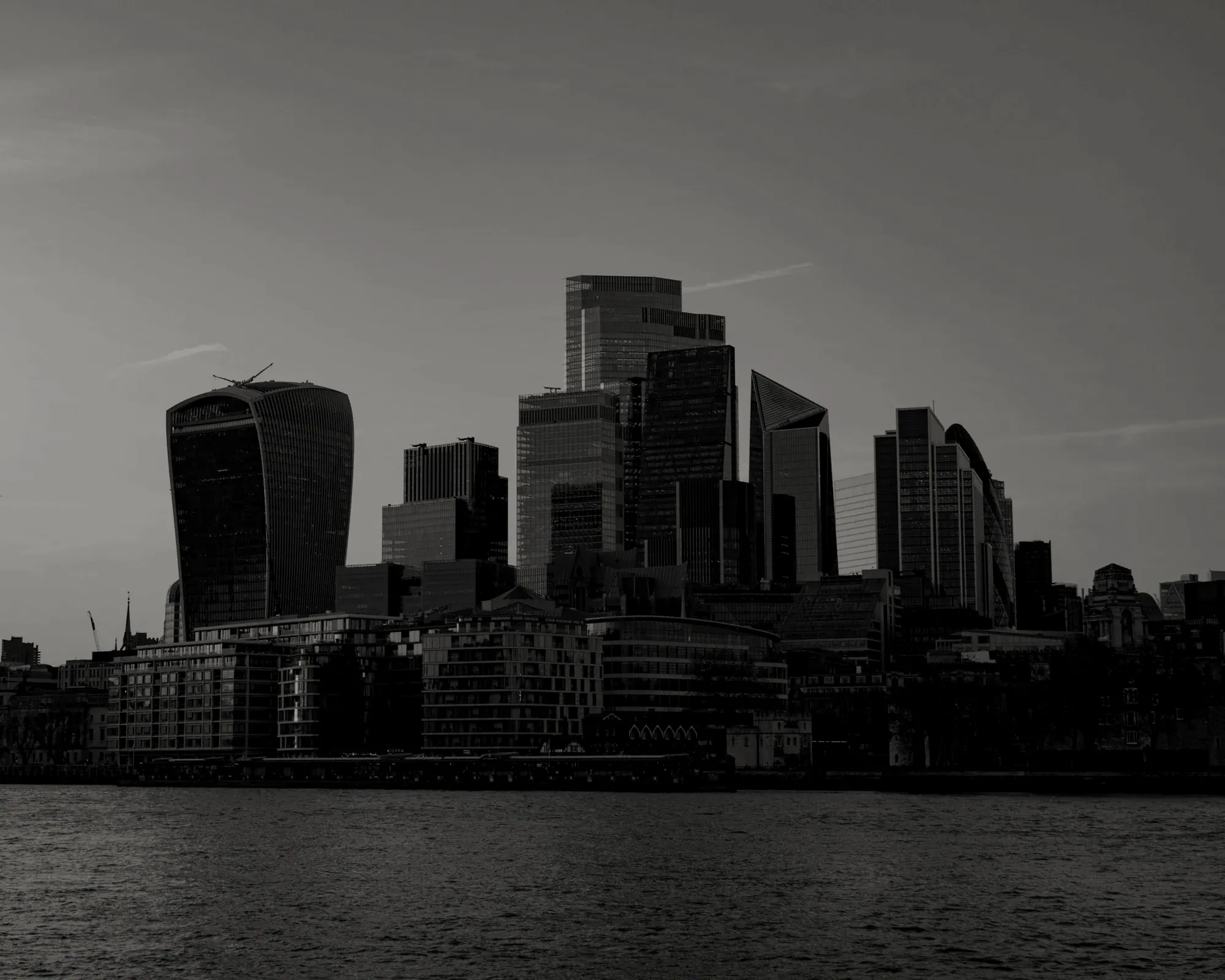
London boroughs and the City
London is the one place in England where a second layer of fire safety policy sits on top of the national rules. We write strategies that satisfy both.
- Reply
- Same-day reply
- Fee
- Fixed, agreed before we start
- Signed off by
- A Chartered Engineer (CEng)
- Coverage
- In-house engineering, UK wide
- Scroll
Overview
Fire strategy for London buildings
The London Plan 2021 adds its own fire safety requirements to the national ones. Policy D12(B) asks every major development to submit a fire statement with its planning application. Major development includes housing schemes of ten or more homes. Policy D5(B5) expects at least one fire evacuation lift per core in developments that have lifts.
A tall residential scheme can therefore face two sets of requirements at planning. One is the national Gateway 1 fire statement and the other is the London Plan. We write the strategy so the two agree with each other and with the drawings. We then carry it forward to Gateway 2 and Gateway 3 where the building is higher-risk.
The Mayor of London Order 2008 sends the largest applications to City Hall, including schemes of more than 150 homes and buildings over 30 metres high outside the City. An amendment in 2026 added schemes of 50 or more homes, which a council cannot refuse without notifying the Mayor, who then has 21 days to take the decision. The Old Oak and Park Royal Development Corporation remains the planning authority for its area. The London Legacy Development Corporation handed its planning powers back to the boroughs on 1st December 2024. The Oxford Street Development Corporation became planning authority for parts of Westminster and Camden on 10th August 2026.
A new London Plan to 2050 is in preparation. Its draft consultation closed on 15th October 2026, with examination expected in 2027 and adoption in early 2028. The Mayor has withdrawn the draft Fire Safety London Plan Guidance and says this does not change the status of Policies D5 and D12. London Fire Brigade says it answers nearly 20,000 consultations on building and planning applications every year.
Who decides
Who approves a fire strategy in London
- Planning
- The London borough or the City of London Corporation (official source, opens in a new tab)
- The local planning authority. The Mayor of London also decides the largest strategic applications.
- London Plan
- The London Plan 2021 (official source, opens in a new tab)
- Policy D12 covers fire safety and fire statements. Policy D5(B5) covers evacuation lifts.
- Building control
- The borough or a registered building control approver (official source, opens in a new tab)
- A higher-risk building takes a different route. The Building Safety Regulator acts as building control for it.
- Fire and rescue
- London Fire Brigade (official source, opens in a new tab)
- A statutory consultee under the Building Regulations. Its fire engineers review complex projects and it may be consulted at planning on major schemes.
Local issues
What a London fire strategy has to deal with.
Two sets of requirements
The national Gateway 1 statement and the London Plan fire statement cover overlapping ground. The strategy has to give the same answer to both.
Evacuation lifts
Policy D5(B5) puts a fire evacuation lift into the core design. It affects the lobby, the power supply and the management plan. It has to be settled early.
Dense sites
On a tight London plot the fire service access, the firefighting shaft and the separation from neighbouring buildings are hard to fit. They need testing in the design, not at the end of it.
Existing buildings put to new use
Offices converted to homes and older buildings extended upwards need a strategy that works with the structure they already have.
Building types
The building types we see in London
- Fire Strategy for High-Rise Residential Buildings
Tall residential schemes and the higher-risk building gateways
- Fire Strategy for Offices and Commercial Buildings
Offices and the conversion of offices to other uses
- Fire Strategy for Heritage Buildings and Conversions
Listed and historic buildings given a new use
- Fire Strategy for Transport and Infrastructure
Stations and interchanges where crowds and smoke control drive the design
Places
Fire strategy across London.
Each of these has its own page, with the council, the plans and the buildings of that place.
What we deliver
Fire strategy services in London.
Planning Fire Statements and Gateway 1
Gateway 1 and London Plan D12, UK wide
Read more
Fire Strategy Reports
New build, refurbishment and change of use, UK wide
Read more
Gateway 2 and Gateway 3 Support
Higher-risk buildings, BSR submissions, UK wide
Read more
Fire Strategy Review and Peer Review
Independent second opinion, UK wide
Read moreCommon questions
Fire strategy questions in London, answered.
Cannot see your question? Get in touch and we will answer it directly.
All fire strategy questionsA major development does. London Plan Policy D12(B) requires a fire statement with the planning application. A building that is also a relevant building under the national rules needs the Gateway 1 fire statement. One scheme can need both and the strategy has to answer each.
Guides
Guides worth reading first.
Other locations
All locationsFire strategy in London
Tell us about the building
Send us the drawings, the building type and the stage you are at. We reply the same day with a clear scope, programme and fixed fee.
- 01Written in-house by the engineer who will defend it to the approver
- 02Approved Document B, BS 9999, BS 9991 and BS 7974
- 03Building Control and fire authority engagement handled for you
- 04Projects of every size, across the UK
Request a quote
Same-day reply