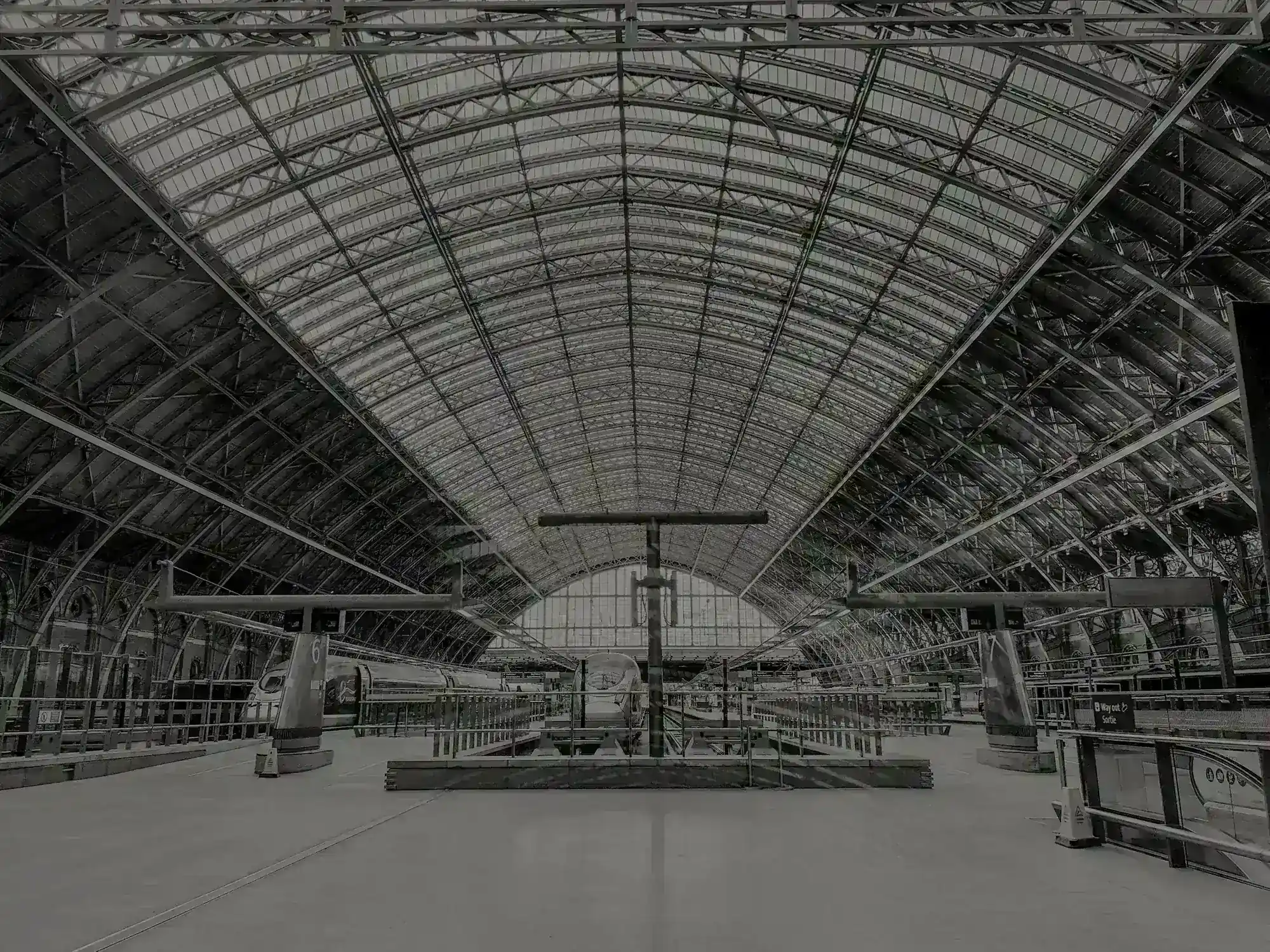
Stations, interchanges, airports and depots
Transport buildings move crowds through large connected spaces that no prescriptive code describes. The strategy is built on evacuation modelling, smoke control and the operator's own standards as much as the Building Regulations.
- Reply
- Same-day reply
- Fee
- Fixed, agreed before we start
- Written to
- BS 7974 engineered approach, Approved Document B and BS 9999, Operator fire safety standards
- Signed off by
- A Chartered Engineer (CEng)
- Scroll
What makes this sector different
What a fire strategy for transport buildings has to answer.
Crowd movement
Peak flows, platform clearance and the evacuation modelling that proves the exits cope.
Large connected volumes
Concourses and interchanges where a smoke reservoir has to be designed.
Operator standards
Rail, aviation and highways bodies bring their own fire safety standards alongside the Building Regulations.
Live operation
Works in a station that stays open throughout.
Evacuation strategy
How evacuation works in stations and terminals
Stations and terminals rarely evacuate everyone at once in the way an office does. Passengers may be moved away from the affected area, trains may be held or run through without stopping and parts of the building can stay open. The strategy defines the evacuation zones and the order in which they clear.
Design is based on time. Evacuation modelling tests whether platforms and concourses can clear before conditions become untenable, using peak passenger numbers and allowing for people with luggage, children and reduced mobility. Smoke control modelling provides the other half of the comparison. Both are run for several fire locations because the worst case is rarely the obvious one.
Our approach
How we write a fire strategy for transport buildings.
We produce engineered strategies for transport buildings using evacuation modelling and smoke control analysis in-house, reconciled with the operator's standards. For works to live assets we produce the interim strategies that keep the facility safe during construction.
Typical deliverables
- Fire strategy report and plans
- Evacuation modelling output
- Smoke control design intent
- Interim strategies for live works
Standards and guidance
Fire safety guidance for transport buildings
- BS 7974 engineered approach
- The basis for most transport strategies. Available safe escape time is compared with the time people need to get out.
- Approved Document B and BS 9999 (official source, opens in a new tab)
- Applied to conventional parts of the building such as offices, retail units and back of house areas.
- Operator fire safety standards
- Rail, metro and airport operators set their own requirements, which usually go beyond the Building Regulations.
- BS EN 12101 smoke control
- The series of standards for smoke and heat control equipment, including ventilators, fans and smoke barriers.
Common questions
Fire strategy questions on transport buildings, answered.
Cannot see your question? Get in touch and we will answer it directly.
All fire strategy questionsYes. We work to the operator's standards alongside the Building Regulations and set out in the strategy where each applies and how any conflicts are resolved.
What we deliver
Services for transport buildings.
Fire Engineering
Performance based design, in-house, UK wide
Read more
Smoke Control and Evacuation Modelling
Fire engineering in-house, UK wide
Read more
Fire Strategy Reports
New build, refurbishment and change of use, UK wide
Read more
Fire Strategy Plans and Drawings
Annotated plans for every storey, UK wide
Read moreOther sectors
All sectorsFire strategy for transport buildings
Tell us about the building
Send us the drawings, the building type and the stage you are at. We reply the same day with a clear scope, programme and fixed fee.
- 01Written in-house by the engineer who will defend it to the approver
- 02Approved Document B, BS 9999, BS 9991 and BS 7974
- 03Building Control and fire authority engagement handled for you
- 04Projects of every size, across the UK
Request a quote
Same-day reply