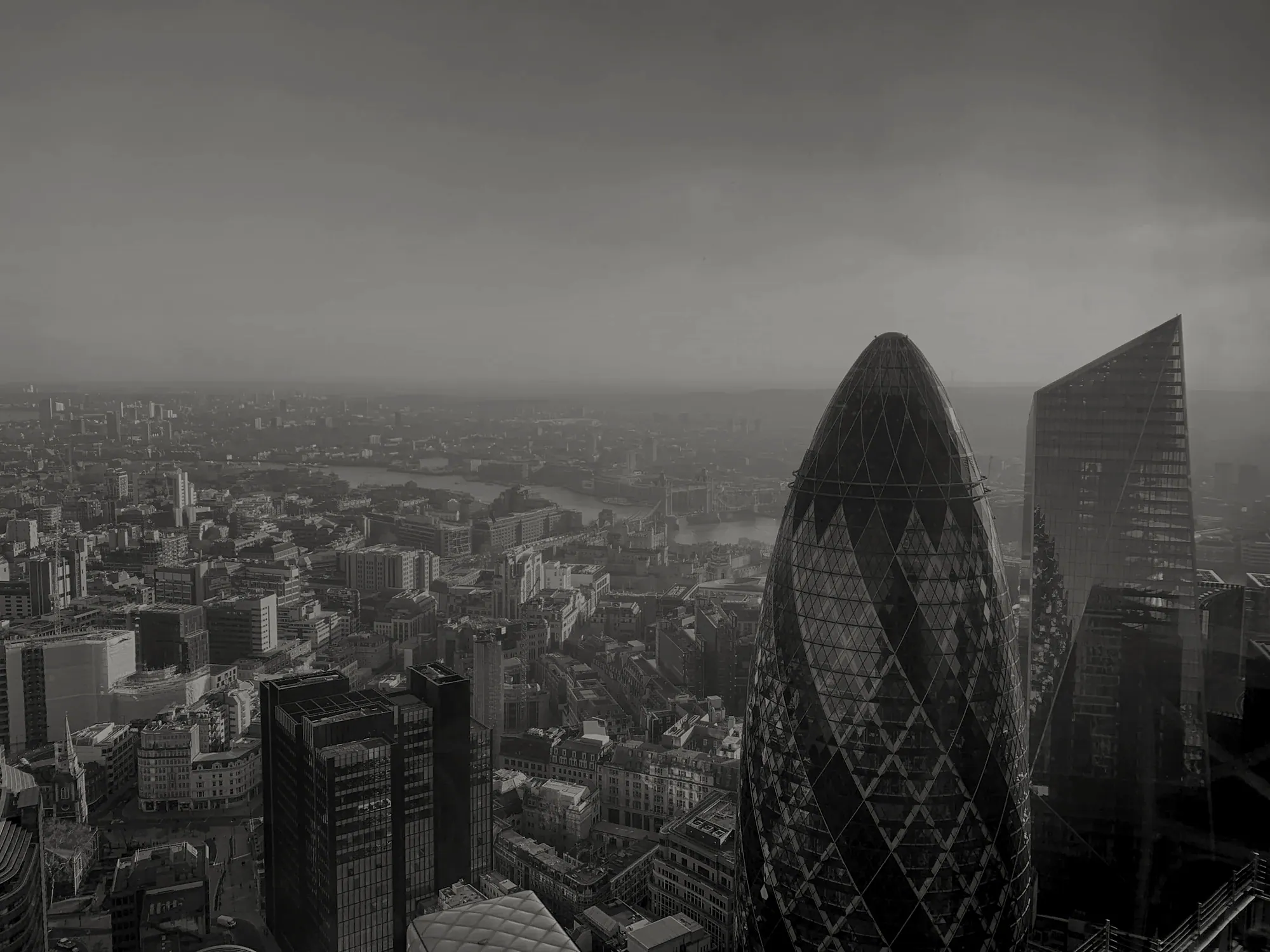
The City Cluster, Fleet Street and the Barbican
The City of London Corporation decides its own planning applications, runs its own building control service and has a single fire station at Dowgate, which is also home to London's Fire Investigation Team. We write fire strategies for City Cluster towers, office refurbishments, civic buildings such as Guildhall and the Barbican's listed residential blocks.
- Reply
- Same-day reply
- Fee
- Fixed, agreed before we start
- Signed off by
- A Chartered Engineer (CEng)
- Coverage
- In-house engineering, UK wide
- Scroll
Overview
Fire strategy for City of London buildings
The Inspectors' report on City Plan 2040, published on 14th October 2026, concludes that the plan is sound subject to the main modifications it sets out. The Corporation says the new plan will replace the Local Plan 2015 once adopted, a step not yet confirmed by mid November 2026. The submission draft plans for at least 1,200,000 square metres of extra office floorspace between 2021 and 2040 and at least 1,706 net additional homes from 2025/26 to 2039/40.
The Minister for Housing and Planning wrote to the Planning Inspectorate asking for further consideration of tall buildings and heritage, in a direction tied to the Tower of London World Heritage Site. After an additional hearing on 2nd September 2026 the Inspectorate concluded that the City Cluster contours in Figure 15 of the plan should remain unaltered.
On Fleet Street the Corporation is funding a £600 million justice quarter at Salisbury Square. It comprises a courts building with 18 courtrooms for economic and cyber crime, a new City of London Police headquarters, a commercial building, a public square and a listed building to be transformed into a hospitality venue. The courts building had been topped out by September 2025.
Who decides
Who approves a fire strategy in City of London
- Planning
- City of London Corporation (official source, opens in a new tab)
- The Square Mile's own planning authority, working from the Local Plan 2015 while City Plan 2040 awaits adoption.
- Building control
- City of London Building Control (official source, opens in a new tab)
- An in-house Corporation service with fire engineering specialists on staff. Work on a higher-risk building is approved by the Building Safety Regulator instead.
- Fire station
- Dowgate Fire Station (official source, opens in a new tab)
- The City's only station stands on Upper Thames Street. LFB's risk plan puts 28 watch members there alongside the Fire Investigation Team.
- City Plan 2040
- City Plan 2040 examination (official source, opens in a new tab)
- The Corporation's page for the Inspectors' report and the tall buildings hearing.
Local issues
What a City of London fire strategy has to deal with.
Towers inside fixed height contours
The submission draft of City Plan 2040 treats any building over 75m above Ordnance Datum as tall and caps heights at the contour rings around the City Cluster. Towers built up to their contour can hold very large office populations, which means stair widths, phased evacuation and firefighting shafts have to be settled before the massing is fixed. LFB records a drill with the Eastern Cluster high-rise group in which 6,500 occupants of one building were evacuated.
Listed market and insurance buildings
Leadenhall Market is listed Grade II* and the Lloyd's Building was listed Grade I in 2011. The draft plan names Leadenhall Market, St Mary Axe, Lime Street and the setting of Bevis Marks Synagogue in its City Cluster policy. Upgrading escape and detection in buildings like these has to work around the fabric and interiors that the listing protects.
Courts and police on one site
Salisbury Square puts 18 courtrooms and a police headquarters beside a commercial building and a hospitality venue. Court buildings generally keep the public, the judiciary and those in custody on separate routes, which escape design has to respect. Different uses sharing one site also need clear compartment lines and coordinated fire service access.
Homes that another station reaches first
LFB says the Barbican Estate, of about 2,000 flats, primarily receives fire cover from Shoreditch Fire Station in Hackney. Because the Barbican is listed Grade II, any change to compartmentation, doors or detection in its blocks has to respect the listed fabric. A fire strategy for the estate also has to assume crews arriving from outside the Square Mile.
Building types
The building types we see in the City of London
- Fire Strategy for Offices and Commercial Buildings
The Grade I Lloyd's Building and City Cluster towers around St Mary Axe and Lime Street
- Fire Strategy for Heritage Buildings and Conversions
Guildhall and Mansion House at Grade I with the Central Criminal Court at Grade II*
- Fire Strategy for High-Rise Residential Buildings
The Barbican Estate, listed Grade II
- Fire Strategy for Hospitals and Healthcare Buildings
St Bartholomew's Hospital at West Smithfield, a centre for heart and cancer care
What we deliver
Fire strategy services in City of London.
Fire Engineering
Performance based design, in-house, UK wide
Read more
Smoke Control and Evacuation Modelling
Fire engineering in-house, UK wide
Read more
Planning Fire Statements and Gateway 1
Gateway 1 and London Plan D12, UK wide
Read more
Fire Strategy Review and Peer Review
Independent second opinion, UK wide
Read moreCommon questions
Fire strategy questions in City of London, answered.
Cannot see your question? Get in touch and we will answer it directly.
All fire strategy questionsAdoption had not been confirmed by mid November 2026, although the Inspectors found the plan sound on 14th October 2026 subject to main modifications. The Local Plan 2015 stays in force until the Corporation adopts the new plan.
Guides
Guides worth reading first.
More in London
All locationsFire strategy in City of London
Tell us about the building
Send us the drawings, the building type and the stage you are at. We reply the same day with a clear scope, programme and fixed fee.
- 01Written in-house by the engineer who will defend it to the approver
- 02Approved Document B, BS 9999, BS 9991 and BS 7974
- 03Building Control and fire authority engagement handled for you
- 04Projects of every size, across the UK
Request a quote
Same-day reply